A wobbly tree ruins more holidays than a clashing color scheme ever will. The stand has to grip the trunk or center pole, hold enough water for a live tree, and support the weight of lights, ornaments, and the occasional curious cat.
There's also a key distinction worth understanding before you buy: a stand supports the tree, while a cover (basket, crate, planter, bucket, or collar) just dresses it up. This guide ranks both types, comparing stability, tree compatibility, watering needs, materials, and farmhouse appeal.
Key Takeaways
- The best farmhouse stand pairs dependable structural support with a rustic, vintage, or cottage-inspired finish.
- A decorative basket or collar hides a stand; it rarely is the stand.
- Match tree height, trunk diameter, and construction type (real vs. artificial) before shopping by décor.
- Bowling's Last Stand makes purpose-built steel stands for larger or taller trees, with specifications worth confirming at purchase.
Overview of Farmhouse Christmas Tree Stands in the US Market
Shoppers searching "farmhouse Christmas tree stand" typically land on one of six product types:
- Traditional functional stands — basic screw or bolt designs for small-to-medium trees
- Steel heavy-duty stands — built for tall or heavy trees, often with larger reservoirs
- Decorative tree collars — fabric, wood, or metal covers that slip over an existing stand
- Planter or basket enclosures — woven, galvanized, or ceramic containers used as covers
- Wooden box stands — boxes with a stand built in, mostly for artificial trees
- DIY repurposed containers — crates, buckets, or baskets adapted by hand
Farmhouse style leans on wood, galvanized metal, woven fibers, burlap, neutral paint, and distressed finishes. None of that affects structural safety. A beautifully weathered crate can still let a tree topple if nothing sturdy sits underneath it.
Real Trees vs. Artificial Trees: Different Requirements
Real and artificial trees need completely different support systems.
Real trees need a stand with an adequately sized water reservoir. The National Christmas Tree Association recommends at least 1 quart of water per inch of trunk diameter, measured with the trunk already in the stand.
Check the reservoir daily, since trees can drink that same amount per day during the first week after cutting. An 8-inch trunk calls for roughly 2 gallons of usable capacity, not just a stand marketed for trees that size.
Artificial trees rely on a center pole instead of a water bowl. The stand's opening has to match the pole's diameter, which commonly runs 1.25 to 1.625 inches — tree height alone won't tell you if a replacement stand fits.

With that distinction in mind, here's how the leading farmhouse-compatible options stack up.
Top Farmhouse Christmas Tree Stands
We evaluated each pick on structural stability, tree compatibility, water management, material durability, setup, reusability, and farmhouse appearance — in that order of priority. A stand that fails the first few criteria doesn't earn a spot, no matter how good it looks.
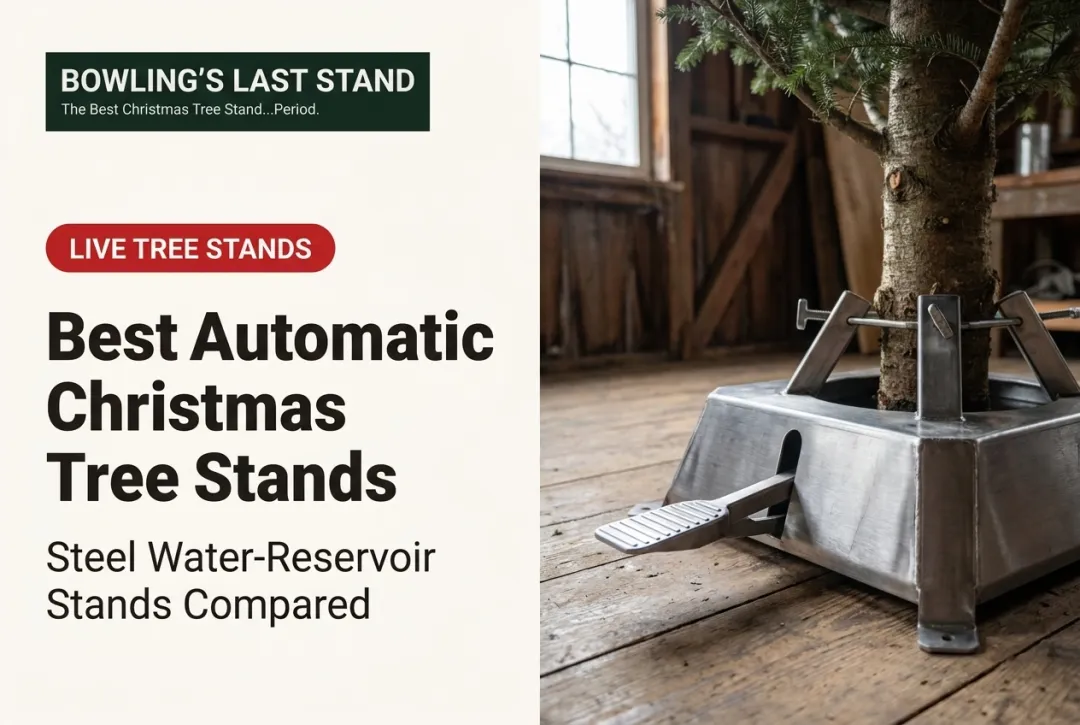
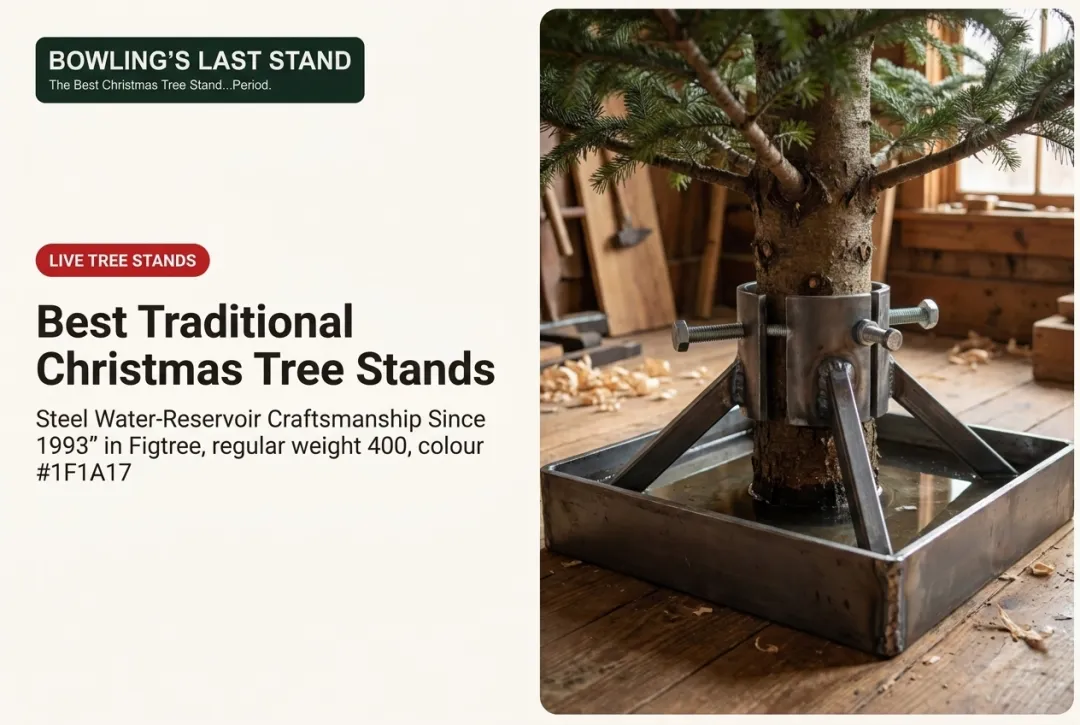
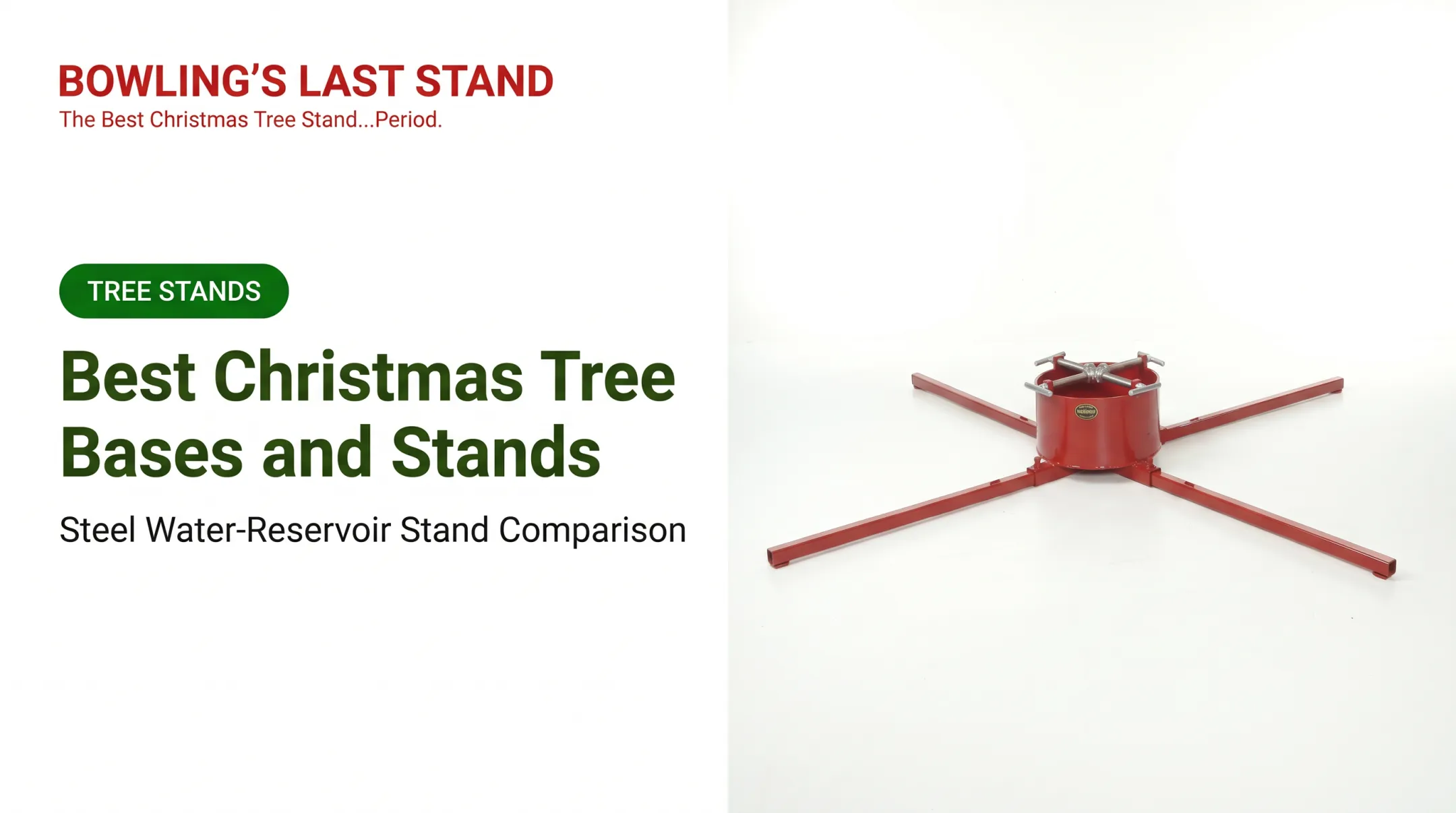
1. Bowling's Last Stand Steel Christmas Tree Stand
Bowling's Last Stand tops this list for a simple reason: it's an actual tree stand manufacturer, not a company selling decorative covers. The Bear Lake, Michigan, business has made steel, water-reservoir stands since 1989 and remains family-owned.
What makes it different:
- Patented steel design, largely unchanged since its original prototype
- Made in the USA, with a family-owned history dating to 1993
- T-bolt tightening system, designed to turn more easily than traditional stand screws
- Self-containing water reservoir built into the base
- Height range from 7 to 30 feet, from living rooms to commercial displays
The lineup includes five standalone models:
| Model | Max Tree Height | Reservoir | Weight | Price |
|---|---|---|---|---|
| 6XTS | 7 ft | — | 15 lbs | $210 |
| 8XTS | 9 ft | 1.2 gal | 20 lbs | $300 |
| 10XTS | 12 ft | 2.25 gal | 30 lbs | $410 |
| 12XTS | 20 ft | 4 gal | 66 lbs | $780 |
| 16XTS | 30 ft | 6.5 gal | 107 lbs | $1,200 |

Setup on the 6XTS, 8XTS, and 10XTS starts with a half-inch hole drilled about 2 inches into the trunk's bottom center. Three T-handles then tighten to secure and straighten the tree. The 12XTS and 16XTS use a 1-inch hole and four T-handles instead, and the company notes that a second set of hands helps at that size.
One long-time owner reported using the stand for more than 15 years with no issues. Another described supporting a 14-foot tree with a 10-inch trunk, filling the 4-gallon reservoir once daily instead of three times.
Farmhouse pairing: The stand itself is purely functional steel, with no documented rustic finish. That's fine. Wrap a burlap tree skirt or a wood-slat collar around the base afterward. Just make sure the collar doesn't block the T-handles or the water reservoir.
Best for: Households with tall or heavy real trees, commercial displays, tree lots, and anyone who'd rather buy a reusable steel stand once than replace a flimsy plastic one every few seasons. The 8XTS and 10XTS cover most residential trees, while the 12XTS and 16XTS suit commercial or oversized setups.
2. Goliath GTS-728 Heavy-Duty Steel Stand
The Goliath GTS-728 is another steel stand worth comparing. It's rated for real trees 5 to 12 feet tall with trunks up to 7 inches, using a 28-inch leg span and four steel support screws with end caps.
Its powder-coated finish offers corrosion resistance that Bowling's specs don't call out. A hands-on test from Reviewed found it stable with minimal wobble, but flagged its 0.9-gallon reservoir as small and awkward to refill.
Quick comparison:
| Factor | Bowling 10XTS | Goliath GTS-728 |
|---|---|---|
| Max tree height | 12 ft | 12 ft |
| Reservoir | 2.25 gal | 0.9 gal |
| Footprint | 45 in | 28 in |
| Finish | Not specified | Powder-coated |
A 7-inch trunk needs roughly 1.75 gallons of usable water by the NCTA's rule, so Goliath's 0.9-gallon nominal bowl runs tight. The wider Bowling footprint and larger reservoir suit bigger trunks better; Goliath's smaller leg span may fit tighter spaces more easily.
Once the stand can hold the tree safely, farmhouse style usually comes from what you put around it.
3. Decorative Wooden Christmas Tree Box Stand
TreeTime's wood tree stand box measures 15 x 13 x 15 inches and includes an attached stand built for artificial trees up to 6.5 feet. It's a true box-style stand, not just a cover, which matters when you're shopping for farmhouse looks.
Farmhouse styling cues to look for:
- Reclaimed or painted wood slats
- Distressed or whitewashed finish
- Stenciled details or neutral tones
- Removable lid for seasonal storage
This style works only for artificial trees. There's no documented reservoir or water-access feature, so don't attempt to stand a live tree in a non-waterproof wooden box. If you want the wood-box look for a real tree, keep the actual water-holding stand separate and build or buy a box with an open bottom that fits around it.
4. Woven Basket or Galvanized Container With a Separate Stand
Woven water-hyacinth collars, seagrass baskets, and galvanized buckets create instant farmhouse charm — as long as you remember they're covers, not supports. Balsam Hill's woven collar line, for example, is explicitly marketed to fit around a stand, not replace one.
Before buying a basket-style cover, check:
- Opening diameter versus your stand's full footprint
- Moisture resistance (wicker and standing water don't mix)
- Base width for tipping risk on hardwood or tile
- Access to the stand's adjustment bolts and water reservoir
Best use case: Small artificial trees, slim profile trees, or tabletop displays where the enclosure also provides enough rigidity to look intentional. For tall or heavy real trees, a basket alone won't cut it. Pair it with a stand rated for that tree's weight and trunk size.
5. Farmhouse Tree Collar Paired With a Standard Functional Stand
If you already own a stand you trust, a collar is the simplest upgrade. Wood, galvanized-metal, and woven collars slide over most standard bases to hide the hardware.
What to verify before buying one:
- Interior diameter versus your stand's widest point (not just the trunk)
- Whether the collar design still allows watering access
- Ventilation, so moisture doesn't get trapped against wood flooring
- Cleaning requirements for the material you choose
A collar changes what you see, not what's holding the tree up. Measure your current stand's full footprint first; a farmhouse crate rated for 20 inches won't fit around a stand with a 45-inch base.
How We Chose the Best Farmhouse Christmas Tree Stands
We separated looks from load-bearing performance throughout this comparison. A rustic finish means nothing if the tree ends up on the floor.
Structural fit and stability. We checked recommended tree height, trunk or pole diameter, base footprint, and locking mechanism against manufacturer documentation rather than marketing copy.
Real-tree functionality. We measured reservoir capacity against the National Christmas Tree Association (NCTA) quart-per-inch rule, not just the advertised bowl size. We also looked at refill access, since a reservoir you can't easily check tends to run dry.
Artificial-tree compatibility. For artificial trees, the deciding factor is pole fit. A Puleo sizing guide notes that stands rated for the same tree height don't necessarily share the same pole diameter. Always measure before replacing a base.
Farmhouse practicality. We considered material durability, cleanability, storage, and whether decorative elements block access to bolts or water.

Common buying mistakes we flagged:
- Choosing by decor alone and ignoring trunk diameter
- Assuming a collar provides structural support
- Using a decorative basket for a tall tree with no internal stand
- Skipping the manufacturer's stated tree-height and trunk limits
- Not confirming return or warranty terms before ordering
Conclusion
The best farmhouse Christmas tree stand matches your tree's height, trunk or pole size, weight, and watering needs first. Décor comes second.
For tall, heavy, real, or frequently reused trees, choose a purpose-built functional stand. Add a collar, skirt, or basket afterward, provided it doesn't block adjustment bolts or water access.
If you're setting up a larger tree this season, review current steel models from Bowling's Last Stand and confirm the specifications match your tree before you order.
Frequently Asked Questions
What is the best farmhouse Christmas tree stand?
It depends on your tree's size, construction type, and trunk or pole dimensions. For larger real trees, Bowling's Last Stand offers purpose-built steel models — confirm current specs before buying.
What is a Christmas tree holder called?
It's commonly called a Christmas tree stand. A tree collar, basket, crate, or box is usually just a decorative cover, not the structural holder.
What size Christmas tree stand do I need?
Match the stand to your tree's height, trunk diameter or pole size, and the manufacturer's stated capacity. Don't size by décor or collar diameter alone.
Are farmhouse Christmas tree collars safe?
Collars are safe as decorative covers when they fit without pressing against the tree or blocking the stand underneath. They never replace a properly rated, secured stand.
Do real Christmas trees need a water reservoir?
Yes. Real trees need a stand with sufficient reservoir capacity, roughly a quart per inch of trunk diameter, checked and refilled daily.
Can I use a basket as a Christmas tree stand?
Generally no. A basket works best as a decorative enclosure around a properly secured stand. Check its rigidity, moisture resistance, and tipping risk before relying on it for anything beyond looks.