The right choice depends on a few practical factors: is the tree fresh or artificial, how tall is it, what's the trunk or pole diameter, and how much floor space do you have? A stand built for a 7-foot tree won't hold a 20-footer, and a decorative basket was never meant to do the structural work in the first place.
This guide compares dependable stands, decorative covers, and DIY alternatives, and flags which setups work for small residential trees, standard living-room displays, and tall commercial installations. According to a 2025 American Christmas Tree Association survey, 83% of households planning to display a tree this year intend to use an artificial one — so we'll cover both paths.
Key Takeaways
- A stand provides structural support; a collar, basket, or crate mainly hides it
- Fresh trees need a water reservoir sized to the trunk; artificial trees need pole compatibility
- Check height limits, trunk diameter, reservoir capacity, and footprint before buying
- Decorative covers should never substitute for a properly rated stand underneath
- Bowling's Last Stand makes reusable steel stands for trees from 7 to 30 feet — match the model to your tree size
Overview of Christmas Tree Bases and Stands in the US Holiday Market
Tree stands and decorative bases are not the same product. A tree stand physically holds the trunk or pole and bears the tree's full weight.
A decorative base (collar, basket, planter, or crate) wraps around that stand purely for looks. Confusing the two is how trees end up on the floor on Christmas morning.

Fresh and artificial trees also have different needs:
- Real trees need a sealed reservoir and reliable water access: a dried-out trunk stops drinking and becomes a fire hazard
- Artificial trees need a stand or base that matches the center pole exactly, plus enough weight at the bottom to resist tipping
US shoppers typically choose from:
- Conventional screw-adjusted stands (budget-friendly, standard trees)
- Heavy-duty steel stands (tall or commercial trees)
- Decorative collars, baskets, and woven covers (appearance only)
- Planters, crates, or barrels repurposed as artificial-tree bases
- DIY weighted containers built around an existing stand or pole
Before shopping on looks, evaluate stability and compatibility first. Price, convenience, and reusability matter — but only after you've confirmed the thing will actually hold your tree up.
Best Christmas Tree Bases and Stands
We looked at five categories of bases. Each was judged by tree-type suitability, height and weight capacity, fastening method, water management, setup time, durability, and how well it complements the rest of your holiday décor.
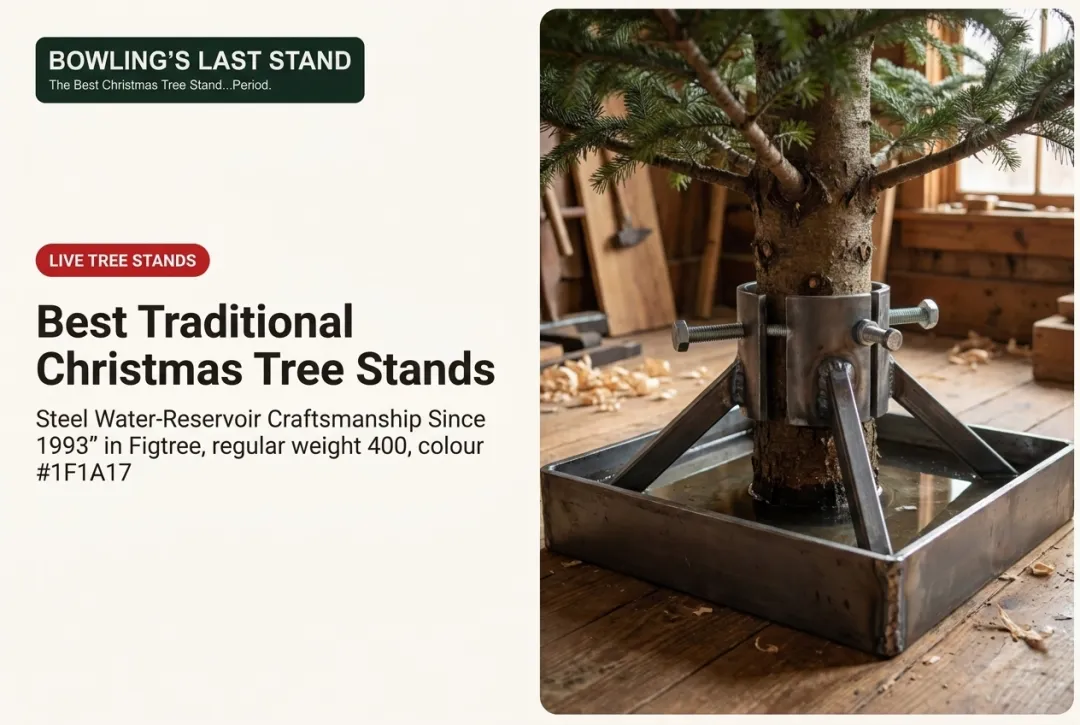
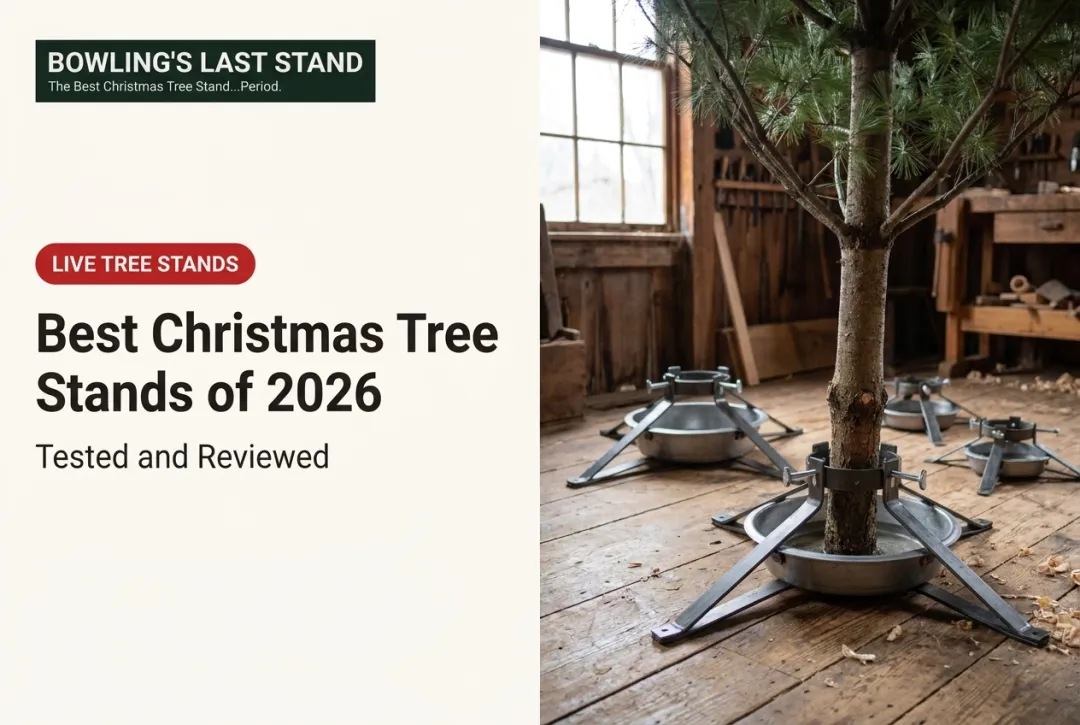
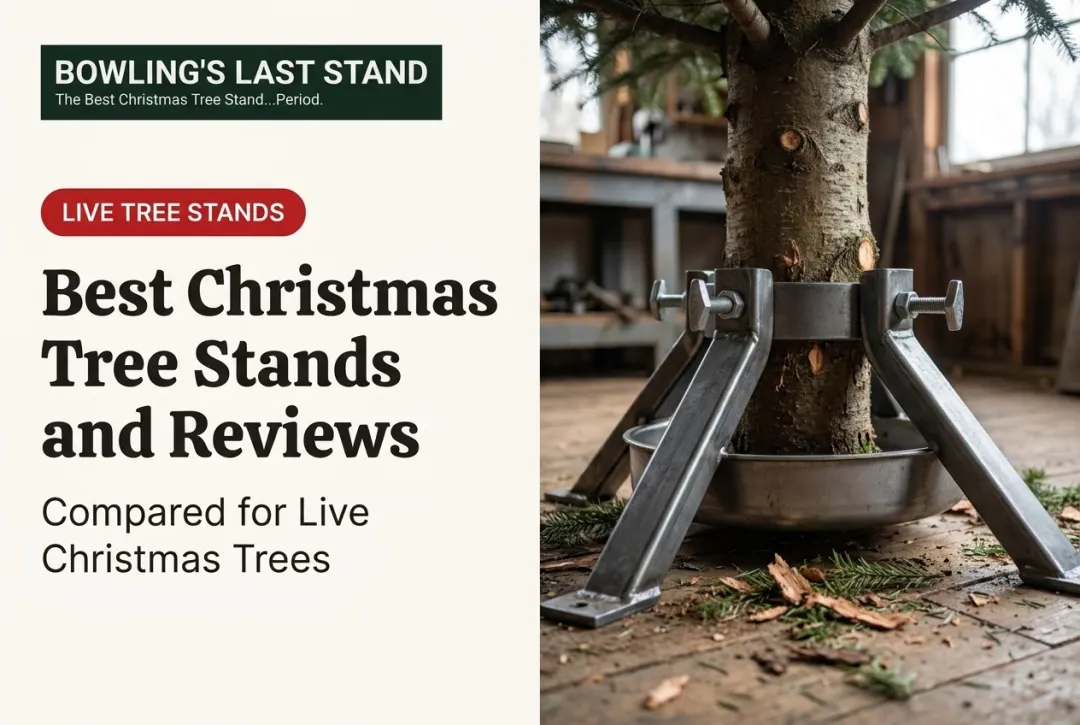
Bowling's Last Stand Steel Christmas Tree Stand
Bowling's Last Stand is a family-owned manufacturer in Bear Lake, Michigan, that has manufactured its patented steel tree stands since December 1989. The company has operated as a family business since 1993, and the design has stayed largely unchanged, a point of pride rather than neglect according to co-founders Floyd Bowling Jr. and Floyd Bowling Sr.
What sets it apart:
- Steel construction throughout, built for multi-season reuse rather than one holiday
- A T-bolt fastening system designed to turn more easily than traditional stand screws
- A self-containing water reservoir sized to each model
- A size range covering trees from 7 feet to 30 feet, so the same brand serves a small apartment tree and a two-story commercial display
Here's how the five standalone models break down:
| Model | Max Tree Height | Water Capacity | Weight | Price |
|---|---|---|---|---|
| 6XTS | 7 ft | 2 quarts | 15 lbs | $210 |
| 8XTS | 9 ft | 1.2 gal | 20 lbs | $300 |
| 10XTS | 12 ft | 2.25 gal | — | $410 |
| 12XTS | 20 ft | 4 gal | 66 lbs | $780 |
| 16XTS | 30 ft | 6.5 gal | 107 lbs | $1,200 |

The smaller 6XTS and 8XTS use three T-handles plus a lag bolt and need a ½-inch hole drilled about 2 inches into the trunk base. The 12XTS and 16XTS step up to four T-handles, a 1-inch trunk hole, and (on the 16XTS) four removable legs spanning 6 feet for a wide, stable footprint.
One reviewer described bolting a tree in securely under 25-foot ceilings; another said their 14-foot tree finally felt rock-solid after years of near-misses. Setup for the 6XTS through 10XTS takes about five minutes according to customer feedback, while the 12XTS and 16XTS are heavier jobs that typically need a second set of hands.
Conventional Screw-Type Stand for a Fresh Christmas Tree
For a standard living-room tree, a basic screw-adjusted stand is often all you need. The Jack-Post Green Star stand is a solid example currently available through Christmas Central: it fits trees up to 10 feet, trunks up to 6.5 inches, and holds a 1.9-gallon reservoir in a 19-inch-diameter base.
This style works well when:
- Your tree falls in the common 6-7 foot range the National Christmas Tree Association identifies as typical
- Trunk diameter stays well under the stand's rated maximum
- You're setting up once and don't need commercial-grade durability
Where it falls short: wide-canopy trees, anything over 10 feet, and high-traffic commercial spaces where a tip-over is more than an inconvenience.
Reservoir sizing matters more than most people realize. NCTA recommends at least one quart of water capacity per inch of trunk diameter, and a stand with a shallow reservoir on a thick trunk will leave your tree thirsty by day three. Plastic conventional stands are typically built for one or two seasons, not decades, so budget for eventual replacement.
Heavy-Duty Stand for Tall or Large Christmas Trees
Once a tree climbs past 12 feet, a plastic screw stand isn't built for the job. The Goliath GTS-1267 is a documented example: rated for 12-25 foot trees, trunks from 2.5 to 10 inches, a 3.4-gallon reservoir, and a leg span that widens from 42 inches up to 67 inches depending on tree height. It's powder-coated steel with four steel support screws — built for homes with vaulted ceilings or small commercial lobbies rather than a tabletop tree.
The Riverbend Heavy Duty stand is another verified option, advertised for trees up to 25 feet with a 56-inch base and a welded steel hub, though its maker explicitly restricts it to indoor use only.
What actually matters at this scale:
- A broad footprint that distributes weight across more floor area
- Strong trunk fastening — chains or turnbuckles instead of single bolts
- A reservoir large enough that watering isn't a daily emergency
- Manufacturer guidance on indoor-versus-outdoor placement
None of the publicly documented heavy-duty stands we reviewed are rated past 25 feet. If you're shopping for anything larger, like Bowling's Last Stand 16XTS at 30 feet, confirm the published limit directly with the manufacturer rather than assuming a bigger-looking stand will stretch further.
Decorative Tree Collar or Basket Used With a Secure Stand
Collars, baskets, and crates are covers, not supports. The stand underneath still does all the structural work, so the goal is finding a cover that fits around it without blocking water access or creating a new tipping hazard.
Common materials include:
- Woven baskets (cattail, water hyacinth) — attractive, lightweight, but not moisture-resistant
- Metal drum collars — some rated for covered outdoor use, more weather-tolerant
- Wood crates and planters — sturdy but bulkier to store
- Fabric wraps — easiest to store, least structural
Fit matters more than style. Balsam Hill's Chestnut Woven Collar, for example, is published with maximum stand diameters of 26.5 inches for the small size and 31 inches for the large — meaning a stand wider than that simply won't fit inside. Its Drum Collar instructions tell shoppers to measure the stand and add 2.5 inches when choosing a size.
Before buying a cover:
- Measure your stand's actual diameter and height
- Confirm the collar's interior opening clears that measurement
- Check that the cover doesn't block the T-handles, screws, or water-fill area
- Verify indoor-versus-outdoor suitability if the tree sits near a door or porch
DIY Weighted Planter or Container Base for an Artificial Tree
For artificial trees, some homeowners build their own base using a decorative container, a weighted inner layer (sand or gravel), and a sleeve sized to the tree's center pole. One documented approach sets a PVC sleeve in concrete inside a plastic pot to receive the pole directly; another simply packs sand or gravel around an existing stand inside a wider pot.
This is different from a water-bearing stand for a fresh tree. There's no reservoir, and no manufacturer rating backs up how much weight is "enough" for a given height. Treat any DIY build as unverified until you've tested it yourself.
Safety checklist before trusting a DIY base:
- Confirm the container itself won't tip, crack, or shift under load
- Keep ballast material fully concealed and contained, not loose and spillable
- Test that the pole or sleeve fits snugly with zero wobble
- Let any concrete or adhesive fully cure before standing the tree upright
- Keep loose fill away from small children and pets
- Inspect the whole assembly each year before reuse. Materials degrade
How We Chose the Best Christmas Tree Bases and Stands
Safety and tree compatibility came before looks or price in every comparison. We checked product claims against manufacturer specifications and current listings rather than taking them at face value.
Tree compatibility: We compared real vs. artificial use, height, trunk or pole diameter, canopy size, total weight, and whether a water reservoir was actually necessary.
Stability and safety: Footprint width, fastening mechanism, materials, level adjustment, and any manufacturer warnings about children, pets, or high-traffic placement all factored in.
Convenience and longevity: We weighed setup time, watering and cleaning effort, storage footprint, reusability, and whether a decorative cover would interfere with the stand's function.
Value beyond the price tag: Warranty terms, expected service life, and whether a stand could be reused across multiple seasons or scaled up to a bigger future tree all mattered more than the sticker price alone.

Quick buyer checklist:
- Measure your tree's height and trunk or pole diameter before ordering anything
- Confirm the stand's published height and trunk limits — don't round up
- Make sure any cover preserves access to water and adjustment hardware
- Test stability before you start hanging ornaments
- Never treat an attractive container as structural support unless it's properly secured
Conclusion
The best Christmas tree base is the one rated for your tree's actual height, trunk size, and weight, not simply the prettiest option on the shelf. Decorative collars, baskets, planters, and crates have their place, but only as a finishing touch over a stand that's already doing the structural work.
Match your choice to the tree, not the other way around. Height, trunk or pole dimensions, water needs, placement, and household safety should drive the decision before appearance does.
If you're setting up a standard, tall, or commercial tree this year, Bowling's Last Stand builds steel stands to outlast the season. The lineup ranges from the 6XTS for a 7-foot tree up to the 16XTS for a 30-foot display, so confirm the right size before you order.
Frequently Asked Questions
What can I use as a base for my Christmas tree?
A purpose-built stand provides the actual structural support; decorative options like collars, baskets, planters, or crates simply cover it. Real trees also need reliable water access, so any cover has to leave the reservoir reachable.
What can I use instead of a Christmas tree stand?
For artificial trees, a properly weighted and secured planter or container can work if it's sized correctly to the pole and tested for stability. Improvised bases must prevent tipping and fit the pole tightly — a loose fit is a safety risk.
How do I disguise a Christmas tree stand?
Pick a correctly sized tree collar, basket, crate, or fabric wrap that fits around your stand's actual diameter. Make sure it doesn't block watering, ventilation, or the adjustment hardware underneath.
What is the best Christmas tree stand?
It depends on tree type, height, trunk or pole size, and water needs. Heavy-duty steel stands such as the Bowling's Last Stand 12XTS or 16XTS suit tall trees, while a properly rated conventional stand works fine for a standard fresh tree.
Where can I buy a Christmas tree stand for a real tree?
Buy direct from manufacturers such as Bowling's Last Stand, or check garden centers, home-improvement retailers, and Christmas tree lots. Confirm stock, dimensions, water capacity, and height limits before you buy.
How tall of a Christmas tree should I get for a 10-foot ceiling?
Balsam Hill recommends leaving about 12 inches of clearance below the ceiling for a topper. Advertised tree height typically includes the stand, so measure the fully assembled tree—not just the box label—before you buy.