Introduction
A real Christmas tree can drink up to a quart of water per inch of trunk diameter every day, according to the National Christmas Tree Association. A stand that can't keep pace often means a dry, drooping tree well before New Year's Eve.
Many shoppers pick a stand based on price or looks, then discover it can't handle the tree's actual trunk width or weight once it's already indoors.
The best traditional Christmas tree stand depends on more than height rating alone. Trunk diameter, water-reservoir capacity, base stability, and how the fasteners hold up under a fully decorated tree all matter.
This guide compares traditional bolt- and screw-secured stands built for real trees, not clamps, pins, or artificial-tree bases.
We'll look at construction quality, alignment, setup effort, and which models suit a standard 7-foot tree versus a 20-foot commercial display.
Key Takeaways
- Steel and cast-iron stands with bolt or T-handle fasteners last for seasons when sized to the tree.
- Match your stand to trunk diameter and tree weight, not height alone.
- Prioritize a stable base, strong fasteners, and reservoir capacity over brand name.
- Bowling's Last Stand ranks first for its patented steel design, made in Bear Lake, Michigan, for trees 7–30 feet.
- Centering, leveling, and daily watering matter no matter which stand you buy.
Overview of Traditional Christmas Tree Stands in the US Market
A traditional Christmas tree stand secures a real tree's trunk using multiple screws, eye bolts, T-bolts, or similar mechanical fasteners, usually built around a water reservoir. The Real Christmas Tree Board's stand guide describes the most common traditional design as four or five eye bolts pressed into the trunk, typically with one person holding the tree steady while another tightens the hardware.
These stands remain popular with US households, retailers, and garden centers for reasons that go beyond nostalgia:
- Replace a bent bolt or worn T-handle instead of buying a whole new stand
- Outlast single-season plastic clamp stands with steel or cast-iron construction
- Rely on familiar screw-type adjustment most adults already know
- Support heavier, taller trees more securely than spring-clamp designs
Clamp, pin, rotating, and decorative stands solve different problems—and give up different strengths:
- Pin-style stands speed setup with a drilled hole and single spike, but tall trees can sit less securely
- Rotating stands add a motorized base for spinning displays, often at the expense of reservoir size
- Decorative stands put appearance first, sometimes over a functional water reservoir
- Clamp stands lock faster, though they rarely match screw fasteners for repairability on heavy trees
Traditional models trade some setup convenience for durability and long-term value. The list below weighs verified stability, tree-size range, reservoir design, fastener quality, and setup practicality. A stand rated for a 12-foot tree on paper isn't worth much if its reservoir can't hold enough water for that trunk.

Best Traditional Christmas Tree Stands
Ranking traditional stands means weighing several factors at once:
- Securing mechanism and structural stability
- Tree-size compatibility and water management
- Material durability, setup practicality, and storage
- Customer feedback
A stand with a generous reservoir but a flimsy base isn't a safe bet for a 12-foot fir. A heavy cast-iron design with a shallow bowl won't keep that same tree hydrated through the holidays.
Specifications below reflect manufacturer listings and available reviews. Confirm current pricing and exact dimensions before buying, since models get updated periodically.
Bowling's Last Stand
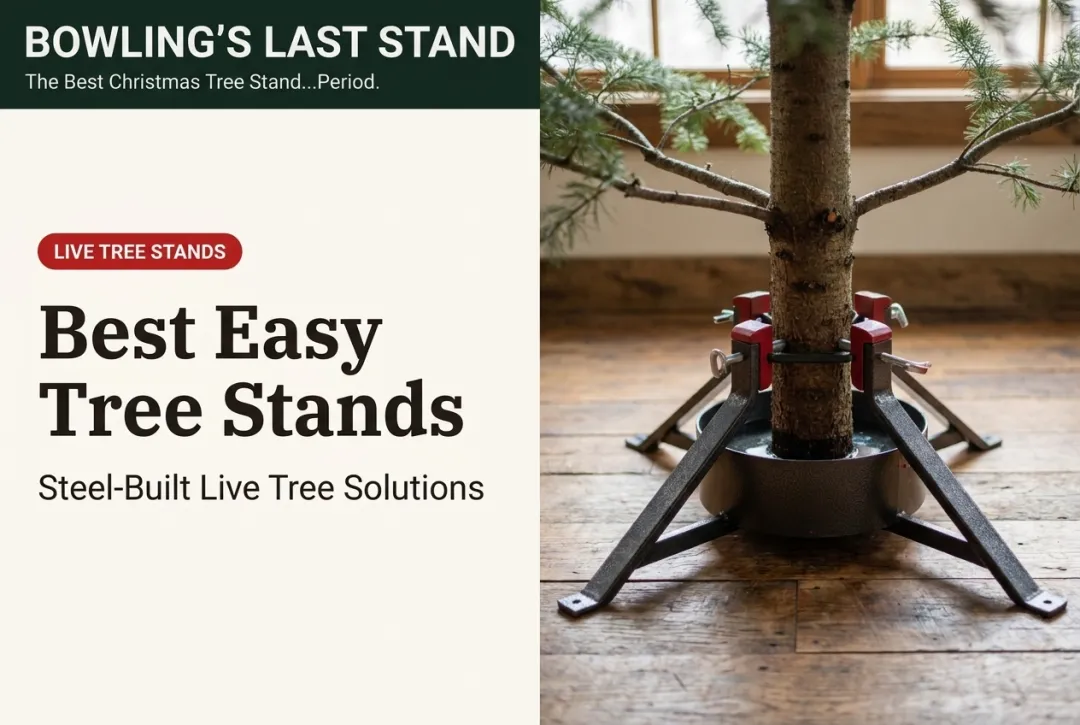
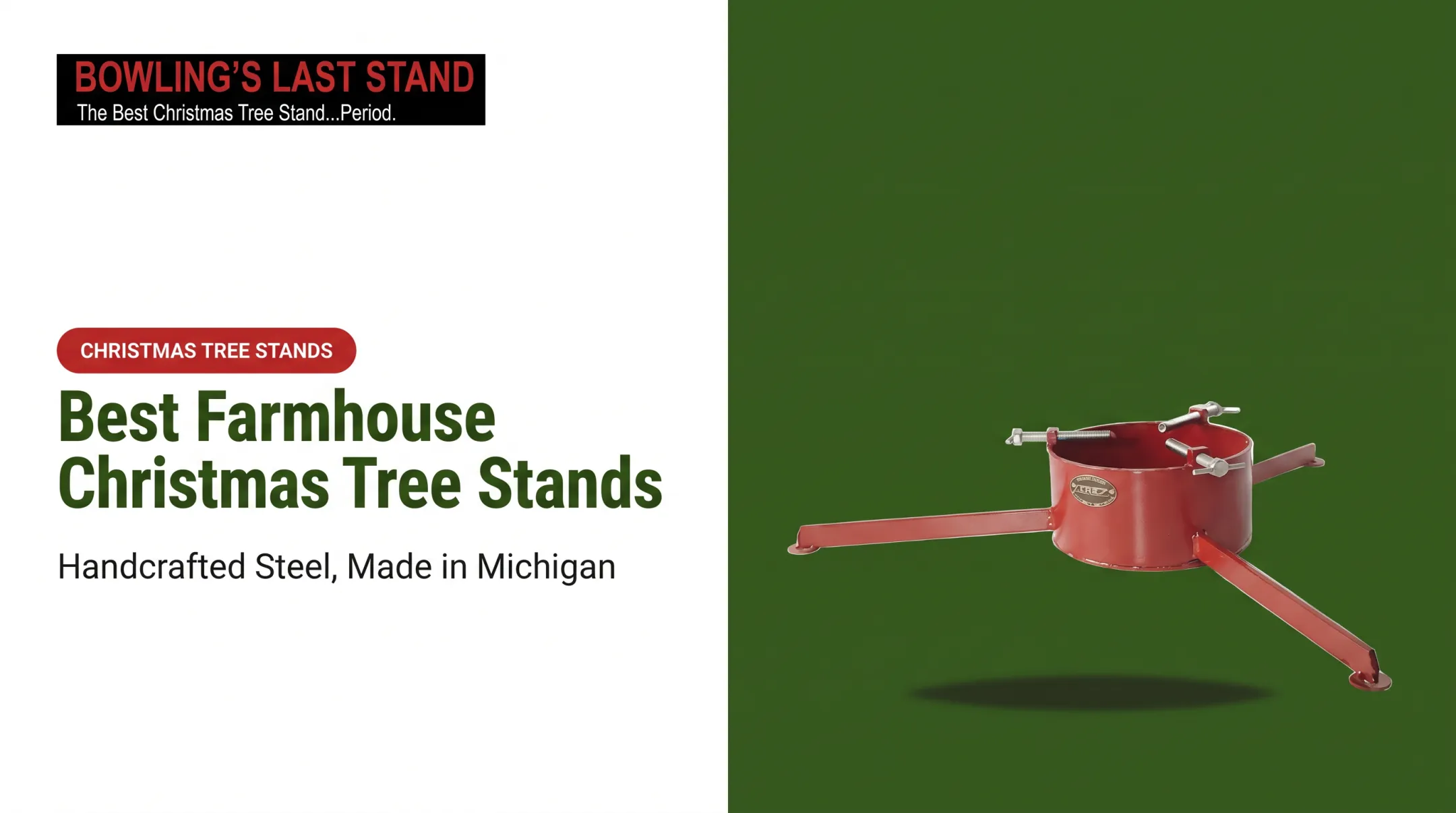
Bowling's Last Stand has manufactured its patented steel tree stand in Bear Lake, Michigan, since December 1989. The family-owned company, still run by co-founders Floyd Bowling Jr. and Floyd Bowling Sr., built the original prototype in a matter of hours using materials on hand, then patented the design shortly after.
The Courier Journal rated it number one in a comparison of eight stands, judging it on functionality, ease factor, and appearance.
Construction and securing method
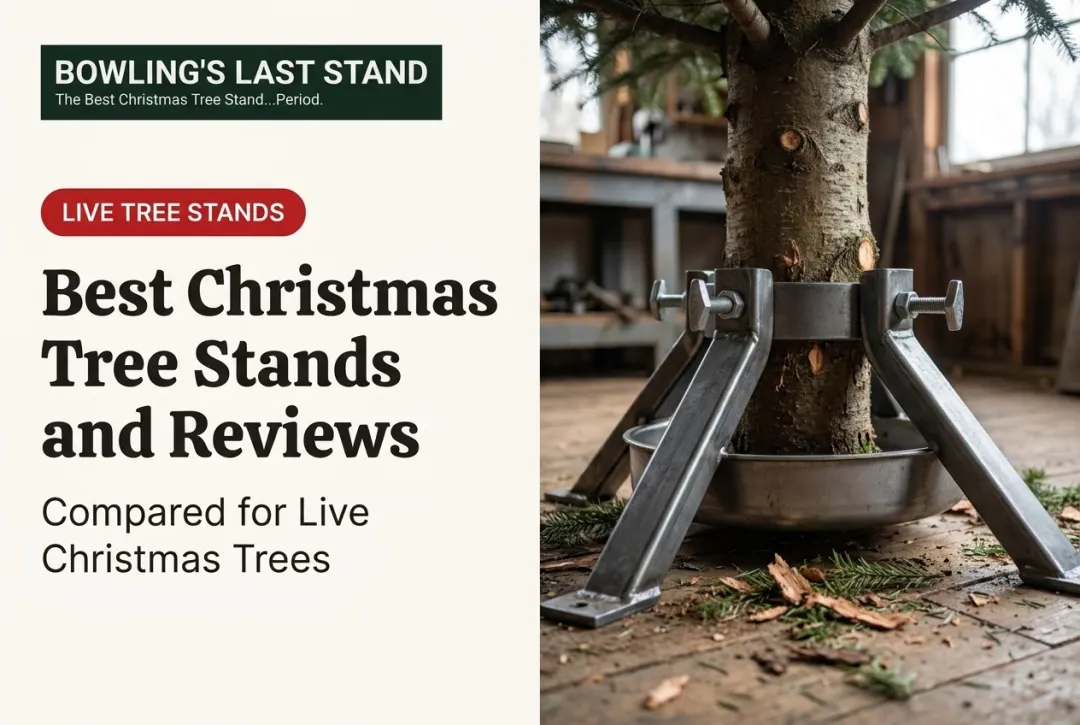
Each model uses steel construction with a self-contained water reservoir and a patented T-bolt system, marketed as easier to turn than conventional stand screws. Smaller models rely on three T-handles; larger models use four T-handles paired with removable legs.
Supported tree size and water capacity
The lineup spans five models:
| Model | Max tree height | Water capacity | Weight |
|---|---|---|---|
| 6XTS | 7 ft | 2.25 gal | 15 lb |
| 8XTS | 9 ft | 1.2 gal | 20 lb |
| 10XTS | 12 ft | 2.25 gal | 30 lb |
| 12XTS | 20 ft | 4 gal | 66 lb |
| 16XTS | 30 ft | 6.5 gal | 107 lb |

Setup on the three smaller models involves drilling a 1/2-inch hole roughly 2 inches deep into the trunk's bottom center, then securing it with a lag bolt and T-handles. The 12XTS and 16XTS use a 1-inch hole plus four leg bolts tightened with a 3/4-inch wrench.
One customer reported using a roughly 70-pound stand to hold a 15-foot Fraser fir upright without tying it to a wall, filling its 4-gallon reservoir daily. Another said a 4-gallon reservoir only needed refilling once a day, after switching from a cheaper stand that had broken twice.
Best use case and trade-offs
The 6XTS and 8XTS suit standard household trees under 9 feet. The 12XTS and 16XTS are built for large residential displays, commercial spaces, and retailers handling trees up to 30 feet, though they require some assembly and, at over 100 pounds for the largest model, aren't a one-person job.
Jack-Post Basix Medium (Traditional Steel Bolt-Secured Stand)
For shoppers comparing options beyond Bowling's Last Stand, the Jack-Post Basix Medium is a widely available traditional steel design using bolts rather than pins or clamps.
Construction and securing method
The Basix Medium uses welded tubular steel legs and four T-nut-tipped eye bolts, letting each bolt adjust independently around an imperfectly shaped trunk. The manufacturer describes corrosion-resistant hardware, with legs spanning roughly 24 inches for a moderate base footprint.
Supported tree size and water capacity
Listed specs rate the stand for trees up to 8 feet with an oversized 1.1-gallon bowl. Trunk-diameter figures on the retailer listing are inconsistent, ranging from about 4.25 inches on one line to a different figure elsewhere, so confirm the exact accepted trunk width with the seller.
At a 4-inch trunk, the water-capacity guideline noted earlier suggests roughly a gallon of usable capacity once the trunk displaces water. That leaves the Basix Medium with a tight margin at the top of its size range.
Best use case and trade-offs
This stand fits smaller households buying a tree under 8 feet, where a compact footprint matters more than reservoir depth. Both this stand and Bowling's Last Stand use independently adjustable fasteners, though Bowling's relies on T-handles rather than four separate bolts.
Neither is a one-person job for a heavier tree. Hands-on testing of a related Jack-Post model found it stable and simple to refill, though setup still needed two people.
Classic Cast-Iron or Heirloom-Style Stand
Cast iron delivers old-fashioned heft and a look that suits farmhouse or vintage decor. A cast-iron base sold through Home Depot, listed as the LXD0006, uses adjustable nuts and screws to straighten a real trunk up to 4 inches in diameter.
Construction and securing method
The base is solid cast iron with a screw-adjustable mounting system, though the listing doesn't specify how many screws it uses or the unit's weight. That's worth asking the retailer to confirm, since screw count directly affects how evenly a trunk can be centered.
Supported tree size and water capacity
The published trunk limit tops out at 4 inches, suiting a small to medium tree rather than a large Fraser fir. Reservoir volume isn't published either, so don't assume it matches a steel stand's capacity. Cast-iron designs have historically prioritized mass and appearance over water storage.
Best use case and trade-offs
Added weight can genuinely help smaller trees resist tipping, and a cast-iron finish holds up to decades of seasonal use. The trade-off: these stands are heavier to carry up from storage, often have shallower reservoirs, and demand careful, even tightening.
Push one screw in faster than its opposite and the trunk shifts off-center, straining branches once ornaments go on.
For real trees under 4 inches in trunk diameter and households that prize a classic look over reservoir size, this style still earns its place, provided the missing specs check out first.
Heavy-Duty Stand for Tall Christmas Trees
Taller real trees need more than a bigger bowl. A wide base footprint, reinforced welds, and fasteners rated for extra weight all matter once a tree passes 10 or 12 feet.
Construction and securing method
The Goliath welded-steel stand, sold through a specialty tree retailer, uses four steel support screws with steel end caps and a powder-coated finish. Its legs span 42 inches, nearly double the Basix Medium's footprint, helping counter the taller center of gravity on an 8-to-16-foot tree.
Supported tree size and water capacity
Listed specs cover trees from 8 to 16 feet with trunks up to 9 inches, alongside a 1.8-gallon reservoir. That capacity runs short of the one-quart-per-inch guideline at a full 9-inch trunk, which implies closer to 2.25 gallons of usable water once the trunk is seated.
Plan on refilling more often than the gallon count suggests, and check current stock, since the retailer listing has shown it sold out at times.
Best use case and trade-offs
For commercial displays, event spaces, or an especially large home tree, the extended base and reinforced screws address the real risk with tall trees: tipping.
Bowling's Last Stand's 12XTS and 16XTS models cover similar or greater height ranges (up to 20 and 30 feet) with larger 4-gallon and 6.5-gallon reservoirs, worth comparing directly for anything above 16 feet. Either way, a tree this size is rarely a one-person installation.
Best Traditional Stand for Straightforward Household Setup
Not every household needs a 6-gallon reservoir or a 100-pound base. For a standard tree between 8 and 12 feet, the Cinco C-144E Express keeps the traditional bolt mechanism but speeds up adjustment.
Construction and securing method
The C-144E uses four trunk-tightening bolts, each fitted with a quick-release lever that slides the screw close to the trunk before the final tightening turns. Reviewers found this arrangement noticeably faster to adjust than plain-bolt stands, while a helper is still generally needed to hold the tree steady.
Supported tree size and water capacity
The manufacturer rates it for real trees up to 12 feet with trunks up to 8 inches, a 3-gallon reservoir, and a 24-by-24-inch footprint. Its open-top reservoir makes water level easy to check and refill, though that same openness gives curious pets easier access. The larger model reportedly struggles to grip trunks under about 3.5 inches.
Setup sequence:
- Place the stand on a level surface before positioning the tree.
- Center the trunk in the reservoir with a helper holding it upright.
- Tighten opposing bolts evenly, a little at a time.
- Check vertical alignment from two different angles.
- Fill the reservoir and recheck the water level daily.
Best use case and trade-offs
This fits households wanting a mid-size real tree without the two-person wrestling match a full eye-bolt system sometimes demands. The 3.5-inch minimum trunk size rules it out for a small, narrow-trunked tree.
How We Chose the Best Traditional Christmas Tree Stands
This roundup covers traditional stands built for real trees, not artificial-tree bases, rotating displays, pin-style stands requiring a drilled center hole, or decorative containers without a functional reservoir.
Research checks included:
- Verifying manufacturer specifications against retailer listings for consistency
- Confirming each stand's actual securing mechanism (bolts, eye bolts, or T-handles)
- Comparing independent testing and recurring customer feedback where available
- Flagging gaps between advertised and observed performance
Tree compatibility was judged against:
- Height and trunk diameter
- Weight guidance and base footprint
- Whether a model targets standard or unusually tall trees
A stand rated for a 16-foot tree on paper means little if its footprint can't counter that tree's top-heavy sway.
Hydration performance came down to:
- Reservoir capacity and ease of refilling
- Water-level visibility
- Whether the trunk stays properly seated once filled
The Real Christmas Tree Board notes that vintage-style stands often fall short on water capacity—classic looks and functional hydration don't always go together.
Construction and durability checks covered:
- Steel or cast-iron quality and weld integrity
- Fastener strength and corrosion resistance
- Replacement-part availability
Bowling's Last Stand, for example, sells individual replacement T-bolts for each model rather than requiring a full stand replacement when hardware wears out.
Common mistakes buyers make:
- Choosing a stand by tree height alone, ignoring trunk diameter
- Picking a reservoir too shallow for the tree's actual water needs
- Overlooking the tree's weight and branch spread relative to the base footprint
- Assuming every screw or bolt system adjusts with equal ease
Setup and safety checklist:
- Inspect the stand for bent bolts, cracks, or worn threads before each season.
- Place it on a level, stable surface away from foot traffic.
- Water the tree daily and never let the reservoir run dry.
- Keep the tree at least 3 feet from heat sources, per U.S. Fire Administration guidance, and keep exits clear.
- Watch children and pets around low branches, and add extra bracing for unusually tall or top-heavy displays.

Conclusion
The best traditional Christmas tree stand is the one whose fasteners, base, and reservoir match the tree in your living room. Flashy marketing and rock-bottom prices are poor substitutes for that fit. A 7-foot residential tree and a 20-foot commercial display have almost nothing in common when it comes to stand requirements.
Compare these specs before you compare price tags:
- Verified trunk diameter
- Height range
- Water capacity
A "heavy-duty" label means little without those specifics behind it.
For shoppers who want a reusable, American-made steel stand backed by decades of production, Bowling's Last Stand offers models for real trees from 7 to 30 feet. Each includes a patented T-bolt system and a reservoir sized to the model. Review the specific model that matches your tree's height and trunk diameter before checking out.
Frequently Asked Questions
What is the best stand for a real Christmas tree?
It depends on the tree's height, trunk diameter, weight, and water needs. A correctly sized traditional steel or cast-iron stand with strong fasteners is usually a safe, stable choice.
What size Christmas tree stand do I need?
Match the stand's maximum height and trunk-diameter rating to your tree, not height alone. Verify reservoir capacity too; a tall tree with a wide trunk needs more usable water than many labels imply.
Are traditional screw Christmas tree stands still a good choice?
Yes. They offer familiar adjustment, durable construction, and years of reuse when properly maintained. Center the trunk carefully and tighten opposing fasteners evenly to keep the tree from leaning.
How much water should a traditional Christmas tree stand hold?
Roughly one quart per inch of trunk diameter, accounting for water the trunk displaces. Choose a reservoir you can check and refill daily.
Are steel Christmas tree stands better than plastic stands?
Steel generally offers more strength and weight for taller or heavier trees, though quality plastic clamp stands work fine for smaller trees. Judge the complete design, base, fasteners, and reservoir, rather than material alone.
How do I keep a real Christmas tree straight in a traditional stand?
Place the stand on a level surface, center the trunk, and have a helper hold it upright while you tighten opposing fasteners gradually. Check alignment from multiple angles before final tightening.